Headspace deserves its popularity. With over 70 million members in 190 countries, a science-backed library of guided meditations, sleep content, focus tools, and mindful movement exercises, all in a beginner-friendly interface narrated by co-founder and former Buddhist monk Andy Puddicombe, it has become many people’s first introduction to meditation.
But as your practice evolves or your mental health needs sharpen, one platform may not cover everything. Maybe you need deeper sleep content with celebrity narrators, or a free library without subscription barriers. Perhaps you’re a skeptic who wants evidence before committing to meditation, or an experienced practitioner ready for non-dual awareness practices. You might be a parent looking for age-appropriate mindfulness tools for your children, or someone dealing with clinical challenges who needs professional therapy rather than an app.
That’s where this guide comes in. Whether you’re looking to:
We’ll explore Headspace alternatives that excel in these areas.
Some readers will use these tools alongside their existing Headspace practice. Others will find a platform that fits their needs better. This isn’t about finding a “better” app; it’s about finding the right fit for where you are in your mental health and mindfulness journey.
Let’s look at the Headspace alternatives that can give you what you’re looking for.
|
Starts at: Free |
Making Therapy BetterBest Alternative for Free, Evidence-Based Therapy Progress Tracking When Mindfulness Apps Are Not Enough
We chose Making Therapy Better because it gives therapy patients validated clinical assessments, progress graphs, and shareable reports to track whether treatment is working — all completely free — designed by one of the world's most cited psychotherapy researchers. |

|
Starts at: $69.99/yr (Consumer); Custom (Enterprise) |
CalmBest Alternative for Enterprise Wellness and Premium Sleep Content
We chose Calm for its sleep content with celebrity narrators, its Calm Health clinical programs, and its employer analytics that exceed traditional EAP engagement rates. |
|
Starts at: Free; $59.99/yr (MemberPlus) |
Insight TimerBest Alternative for a Massive Free Content Library and Community-Driven Meditation
Insight Timer offers over 300,000 free resources from 20,000+ teachers in 50 languages, live meditation events every hour, and community features Headspace doesn't offer, all without a paywall. |
|
Starts at: Free (3 courses + 50 meditations); $99.99/yr |
Happier (formerly Ten Percent Happier)Best Alternative for Skeptics Who Value Expert-Led Instruction and Educational Depth
Happier was built for people who think meditation is "hokey," offering a no-BS approach with teachers like Joseph Goldstein and Sharon Salzberg, educational video content, and a free Dalai Lama course. |

|
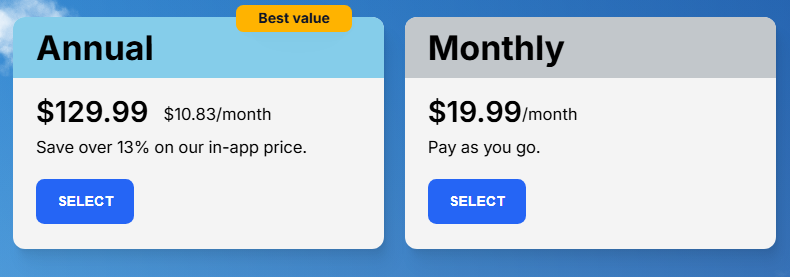
Starts at: Free (scholarship); $129.99/yr |
Waking UpBest Alternative for Deep Philosophical Meditation and Non-Dual Awareness
Created by neuroscientist Sam Harris, Waking Up goes beyond stress reduction into contemplative practices from Dzogchen, Zen, and Advaita Vedanta, with a scholarship program that makes it free for anyone who can't afford it. |
|
Starts at: Free (100%) |
Smiling MindBest Alternative for Families and Children Seeking Completely Free Mindfulness Programs
A nonprofit with 12+ years of free access, Smiling Mind offers 700+ sessions, 16 child-focused collections for ages 5-12, and an evidence-based Mental Fitness Model, all with no paywalls, no ads, and no upsells. |
|
Starts at: Free (1-year trial); $69.99/yr |
BalanceBest Alternative for AI-Powered Personalization That Adapts to Your Progress
Balance assembles custom meditations from thousands of audio clips based on your daily mood, skill level, and goals, with a one-year free trial that gives you twelve months to build a habit before paying anything. |

|
Starts at: Free (MBC); $49/mo (EHR) |
CarePathsBest Alternative for Professional, Measurement-Based Therapy When Mindfulness Apps Are Not Enough
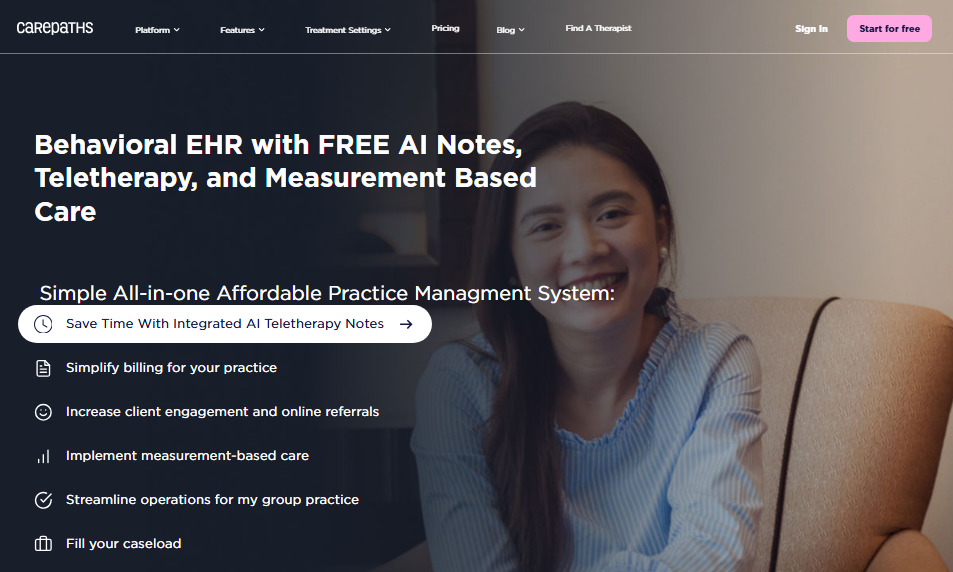
We chose CarePaths because it bridges the gap between consumer wellness apps and professional mental health treatment, giving licensed therapists a complete EHR, automated outcome tracking, and integrated teletherapy at a transparent price. |
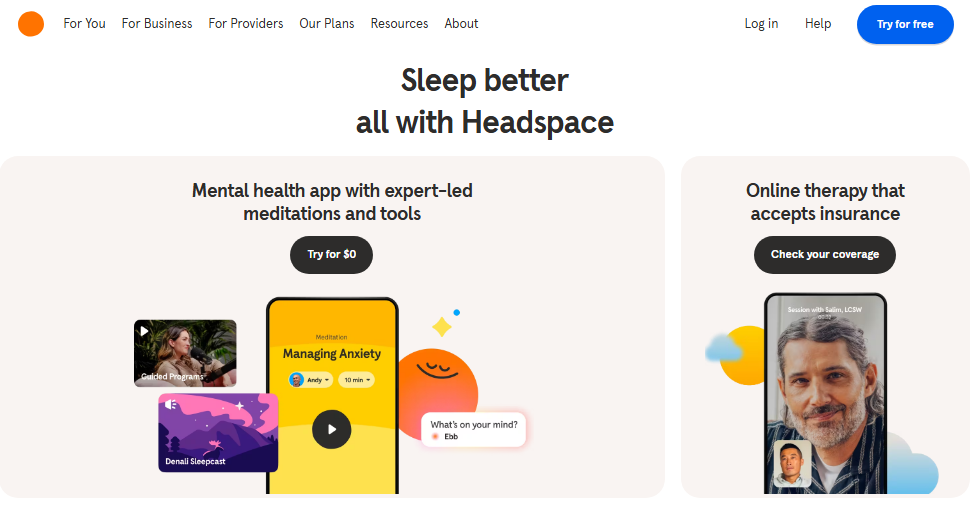
Headspace is a digital mental health platform that has grown well beyond its origins as a meditation app. Founded in 2010 by former Buddhist monk Andy Puddicombe and marketing professional Richard Pierson, it now offers guided meditations, sleep tools, mindful movement exercises, focus content, and clinical mental health services (including coaching, therapy, and psychiatry through Headspace Care).
Its key features include:
What makes Headspace work is how these elements connect. A user dealing with work stress might start with a focus meditation during the day, use a Wind Down before bed, listen to a Sleepcast at night, and then access a coaching session for deeper support. The structured, beginner-friendly approach, combined with Puddicombe’s teaching style, has made meditation accessible to millions who might never have tried it.
However, as your needs become more specific (deeper sleep content, community practice, philosophical meditation, family programming, or professional therapy), a more specialized tool may serve you better. That’s what this guide covers.
After testing Headspace and researching the mental health and wellness app market, we focused on tools that serve specific needs well. Headspace excels at structured introductions to meditation and broad wellness, but some users need more specialized solutions for:
Each tool on this list excels in one of these areas. You might use them alongside Headspace or switch entirely; it depends on your needs.
❗DISCLAIMER: We aren't covering every mindfulness or mental health tool\! Our focus is on the best alternatives that address specific needs beyond what Headspace offers.
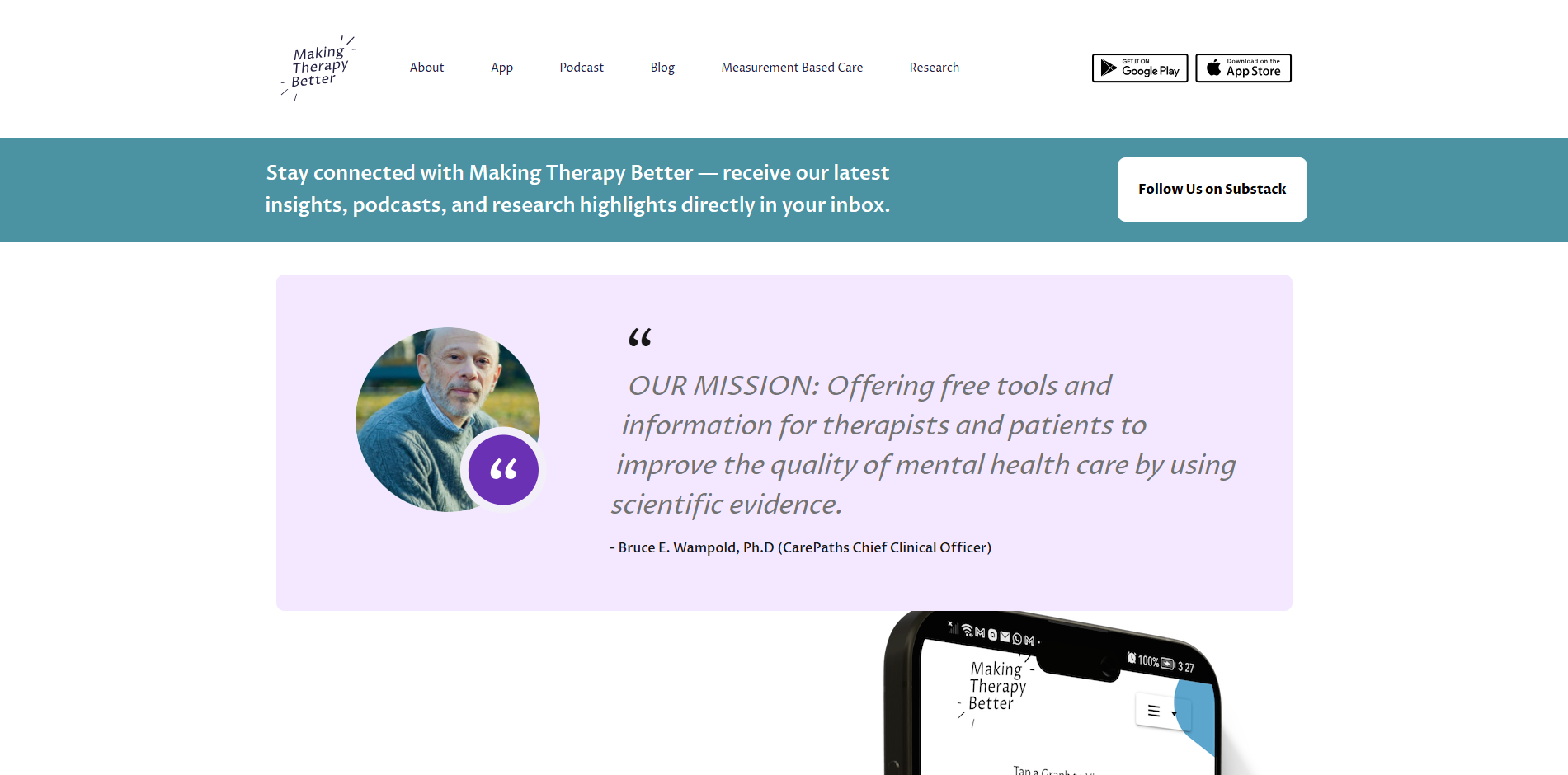
Making Therapy Better is a free mobile app and educational platform built around Measurement-Based Care (MBC) — the practice of routinely tracking symptoms, well-being, and the therapeutic relationship during therapy.
Designed by internationally recognized psychotherapy researcher Dr. Bruce Wampold (Professor Emeritus at the University of Wisconsin-Madison, author of 200+ peer-reviewed articles and 8 books including The Great Psychotherapy Debate), the app puts validated clinical tools directly in patients’ hands so they can monitor whether therapy is working and share structured data with their therapist.
Making Therapy Better is an initiative of CarePaths Inc., a behavioral health EHR company co-founded by clinical psychologists Dr. Geoff Gray and Dr. Maureen Hart. While CarePaths provides the full clinical infrastructure for licensed therapists, Making Therapy Better is the free, patient-facing layer designed for anyone currently in therapy who wants to get more out of it.
Its key features include:
Making Therapy Better occupies a different space than Headspace and the other meditation apps on this list.
While Headspace provides self-guided mindfulness tools and has expanded into coaching and therapy through Headspace Care, Making Therapy Better serves people who are already in professional therapy and want to make that therapy more effective through data. It’s the right choice for readers who have realized that meditation apps alone aren’t addressing their mental health needs and are working with a licensed therapist — or ready to start.
Making Therapy Better isn’t a direct competitor to Headspace. It addresses a gap no meditation app can fill: giving therapy patients the tools to track whether their treatment is actually working, and empowering them to have more productive conversations with their therapist.
Here’s what makes Making Therapy Better valuable for readers of this article.
The key differentiator is Making Therapy Better’s emphasis on Measurement-Based Care, designed by Dr. Bruce Wampold — one of the most cited psychotherapy effectiveness researchers in the world.
While Headspace tracks meditation streaks and minutes meditated, Making Therapy Better sends validated clinical assessments to patients’ phones on a structured weekly schedule.
Monday covers depression and anxiety symptoms. Wednesday measures well-being and loneliness. Friday captures confidence in your therapist and treatment — two items specifically designed to surface therapeutic relationship problems before they cause dropout.
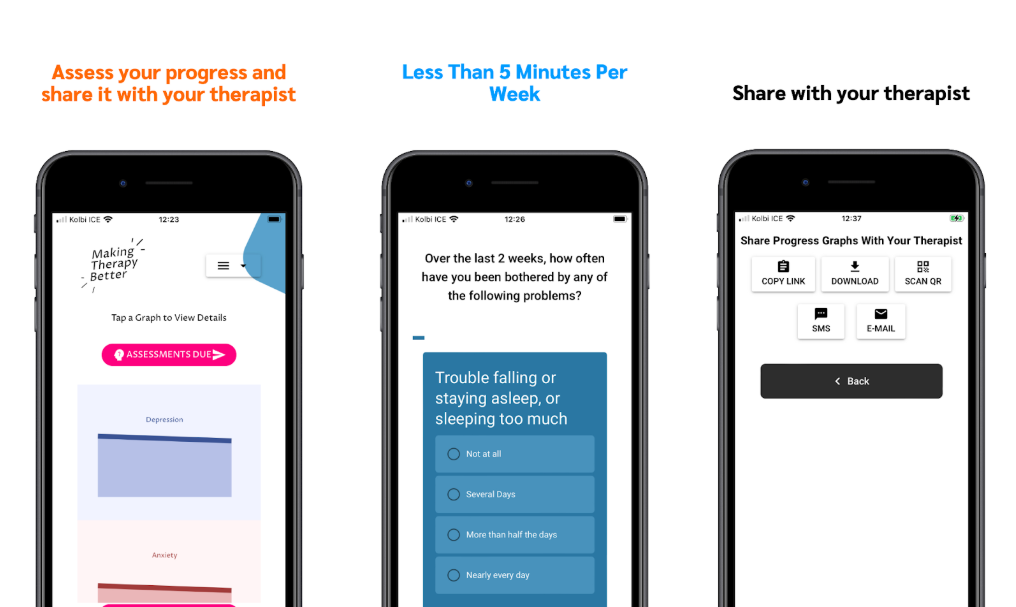
Source: Making Therapy Better
This matters because MBC is recommended as an evidence-based practice by both the APA and the American Psychiatric Association, and research consistently shows it improves therapy outcomes — particularly for patients who are off-track.
Rather than relying on subjective impressions of how therapy is going, both you and your therapist can see whether symptoms are improving, holding steady, or worsening.
For someone who has been using Headspace to manage anxiety or depression and finds that self-guided meditation isn’t producing enough improvement, Making Therapy Better represents the next step: structured self-monitoring that makes professional therapy sessions more productive.
Most MBC systems require a clinic or therapist to deploy them.
Making Therapy Better puts the tool directly in the patient’s hands, so you can begin tracking immediately and share data with any therapist — including those whose practices have never heard of MBC. The platform even provides scripted language you can use to introduce the concept to your therapist, anticipating the adoption friction most patients feel.
This independence is critical.
You don’t need your therapist’s permission, their specific EHR, or any technical setup. Download the app, answer a few questions a few times per week, and bring the graphs to your next session.
Unlike wellness apps that only track mood or meditation streaks, Making Therapy Better’s assessment battery explicitly measures well-being, loneliness, therapeutic confidence, and medication adherence — dimensions that symptom scales alone miss.
The inclusion of therapeutic relationship items is particularly distinctive: research shows the quality of the alliance between patient and therapist is one of the strongest predictors of therapy outcomes, yet most patients have no structured way to reflect on it between sessions.
Making Therapy Better extends beyond the app into a multi-format educational ecosystem.
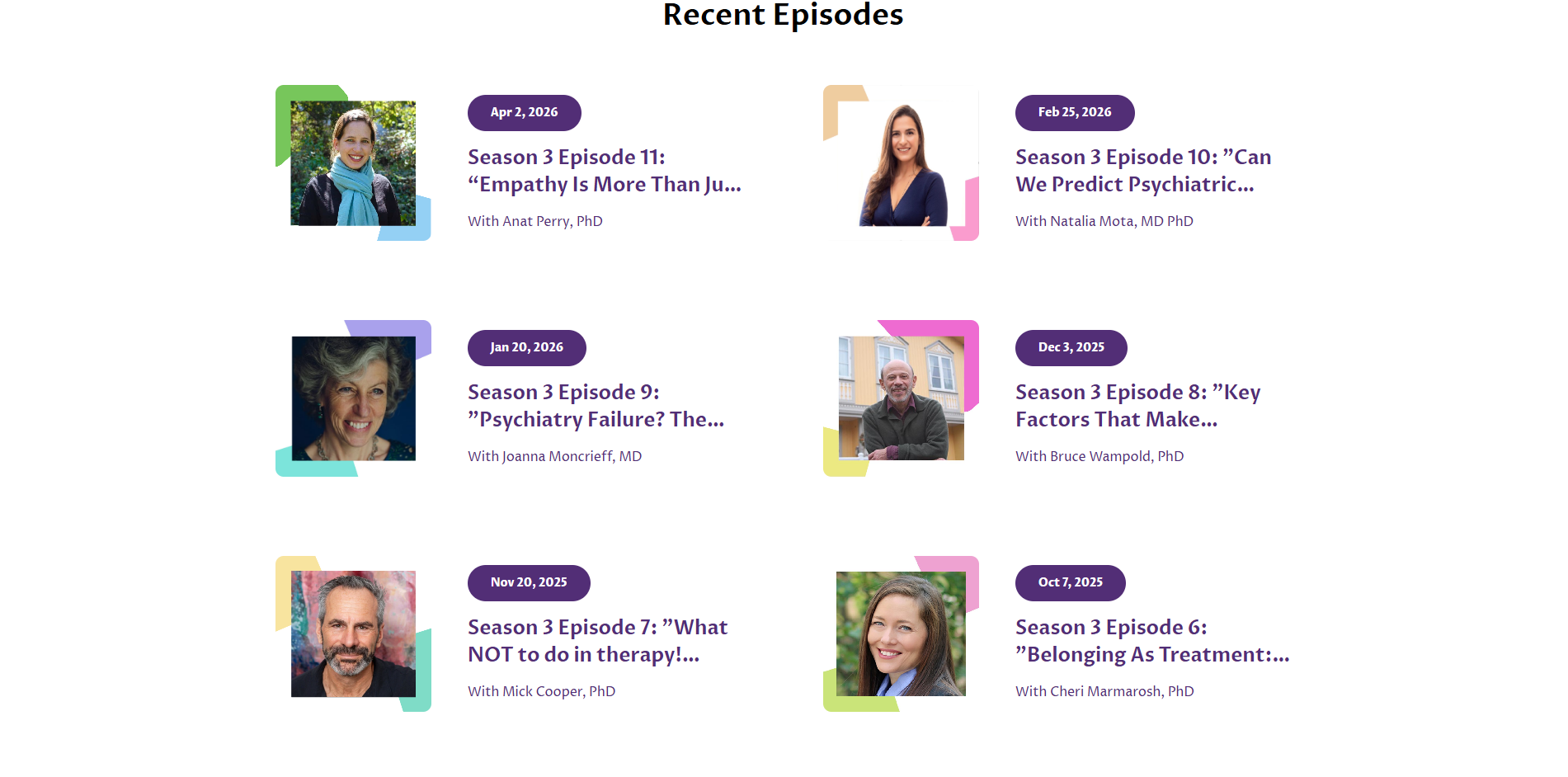
The podcast — now in its third season — features interviews with leading researchers at major universities, hosted by Dr. Wampold. The research page distills the peer-reviewed MBC literature into practitioner-facing takeaways, honestly acknowledging limitations (such as the fact that MBC does not automatically make individual therapists more effective over time).
This candor reinforces credibility with clinically sophisticated audiences and distinguishes Making Therapy Better from marketing-driven wellness content.
For therapists seeking the full clinical infrastructure — electronic health records, automated MBC delivery, teletherapy, billing, and patient portal — CarePaths EHR provides the all-in-one practice management platform behind Making Therapy Better.
CarePaths pricing starts at $49/month per licensed therapist and includes a free MBC tier for up to 30 clients. Therapists can also leverage MBC data for Remote Therapeutic Monitoring (RTM) billing using CPT codes, creating a revenue opportunity alongside better patient outcomes.
Choose Making Therapy Better if:
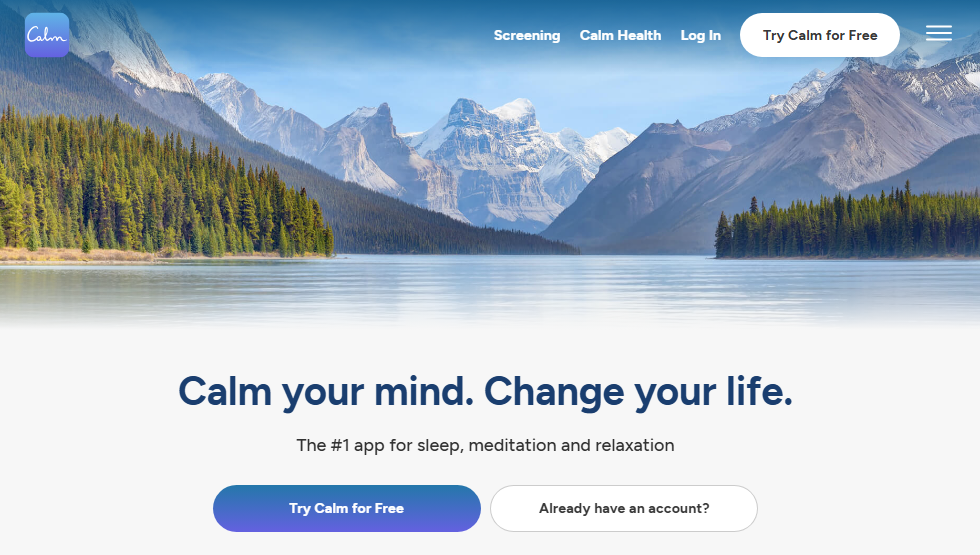
Calm is a mental health and wellness platform that has evolved from a meditation app into a solution serving both consumers and enterprises. With over 180 million downloads and a $2 billion valuation, Calm has carved out a distinct position through celebrity-narrated Sleep Stories, clinical mental health programs through Calm Health, and enterprise wellness solutions.
Its key features include:
Calm stands out in several areas:
Sleep-First Content Library with Celebrity Narration.
While Headspace offers Sleepcasts narrated by professional voice actors, Calm has made sleep its primary differentiator with 500+ Sleep Stories that have surpassed 100 million listens. The stories run approximately 45-55 minutes with non-linear structures that prevent listeners from tracking plot progression, and they’re remixed each night for a slightly different experience each time.
The celebrity narrators appeal to users who might not call themselves “meditators.” For organizations, this lowers adoption friction: employees engage more readily with voices they already know.

Source: Calm
Clinical Mental Health Programs Through Calm Health.
Calm Health offers psychologist-developed clinical programs for mental health conditions, physical conditions, life experiences, and occupational challenges, including a partnership with Mayo Clinic for cancer-specific mental health programs.
The platform uses GAD-7 and PHQ-9 screenings with algorithmic personalization that routes users to appropriate intervention levels. Among users with moderate-to-severe anxiety or depression, 26% engaged in therapy, representing a 1x higher engagement rate in outpatient mental health care versus baseline groups.
Enterprise Analytics and Organizational Insights.
Calm Health provides five analytics and reporting tools for employers: mood check-ins, content topic engagement, user portraits, industry benchmarking, and employee sentiment surveys. All data is anonymous and aggregated to protect privacy. The platform achieves 77% screening completion rates and members are twice as likely to engage in outpatient mental health care compared to baseline groups.
We also evaluated Insight Timer and Happier for this archetype. While Insight Timer offers a large free library with community features, and Happier provides skeptic-friendly instruction, Calm offers the most complete enterprise mental health solution for organizations needing clinical programs, EAP integration, validated screenings, and employer analytics.
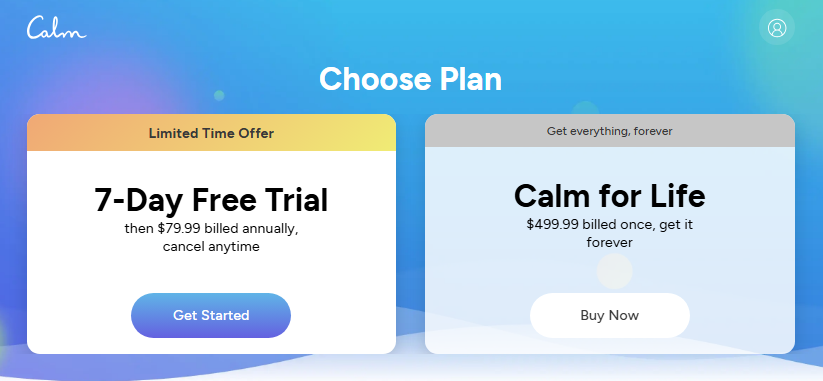
Source: Calm
Choose Calm if:
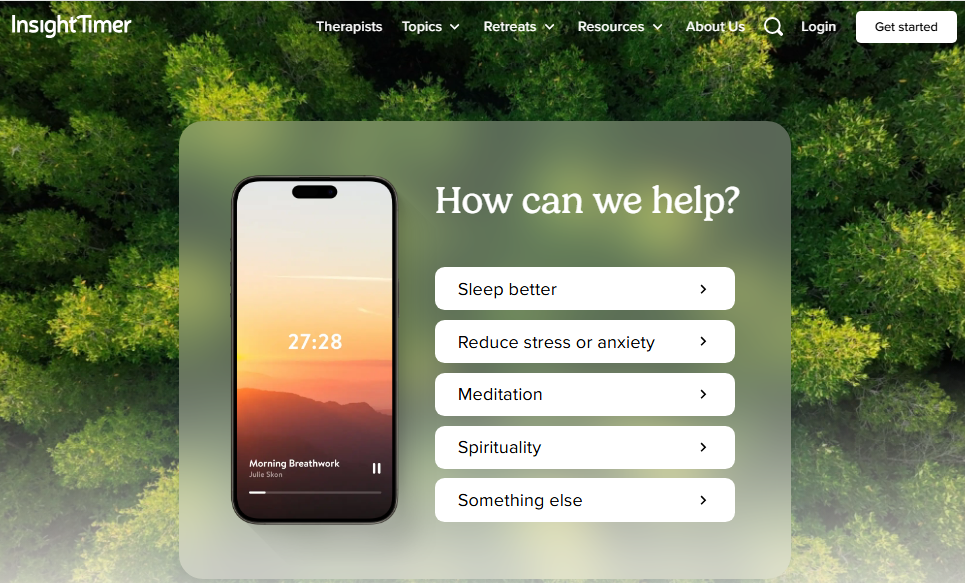
Insight Timer calls itself the world’s largest emotional health, sleep, and mental wellbeing platform, and the numbers support that claim. With an ad-free library of 300,000 free resources in 50 languages from more than 20,000 teachers worldwide, the platform sets itself apart from Headspace through its freemium model and community-driven approach.
Its key features include:
Insight Timer stands out in several ways:
Free Content That Removes Financial Barriers.
The most immediate difference is scale and cost. Insight Timer provides streaming access to over 250,000+ guided meditations and music tracks as a registered user.
Headspace requires a $12.99 monthly or $69.99 annual subscription for full library access. Research shows that GAD-7 scores for anxiety decreased in users who used Insight Timer for 10 minutes daily for 30 days, confirming the free content delivers measurable mental health benefits. The platform accounts for 63% of all time spent on meditation apps in the US, with more time spent on Insight Timer than all other mental wellbeing apps combined.
Live Community Events and Real-Time Teacher Interaction.
Where Headspace offers only pre-recorded content, Insight Timer hosts live meditation and yoga sessions every hour where participants interact with teachers in real time. The Group Meditation feature lets users meditate simultaneously with friends, family, or colleagues, each person listening to their own preferred track while practicing together. All Live Events are free. This community approach directly addresses the isolation many people feel in solo practice.
Teacher Diversity.
Where Headspace has been synonymous with Andy Puddicombe’s voice and style, Insight Timer offers content from more than 20,000 teachers representing diverse traditions, including meditation experts, neuroscientists, psychologists, and teachers from Stanford, Harvard, and Oxford, alongside experts such as Dr. Richard Schwartz (founder of IFS), Tara Brach, Kristin Neff, and Rick Hanson.
Content spans diverse meditation styles including Buddhist mindfulness, Kundalini yoga, walking meditation, and many others. The trade-off: Insight Timer takes more effort to navigate, but for many users the abundance is worth it.
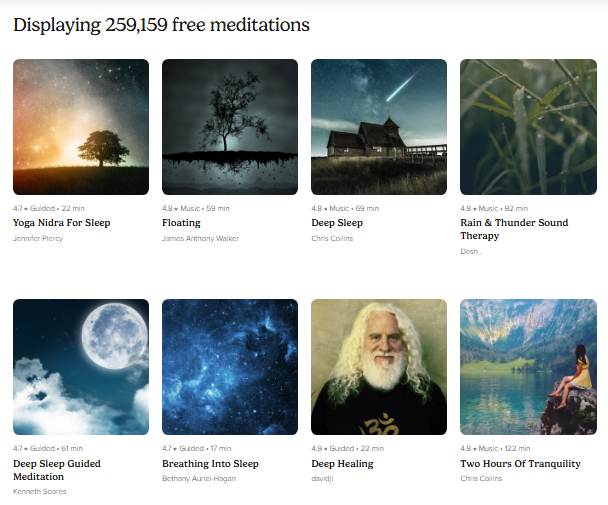
Source: Insight Timer
We also evaluated Calm and Happier for this archetype. Calm has a large paid library, and Happier offers quality content for skeptics, but Insight Timer offers the most complete free meditation experience. Calm's free tier is far smaller than Insight Timer's 300,000+ free sessions, and Happier gates most content behind a paywall.
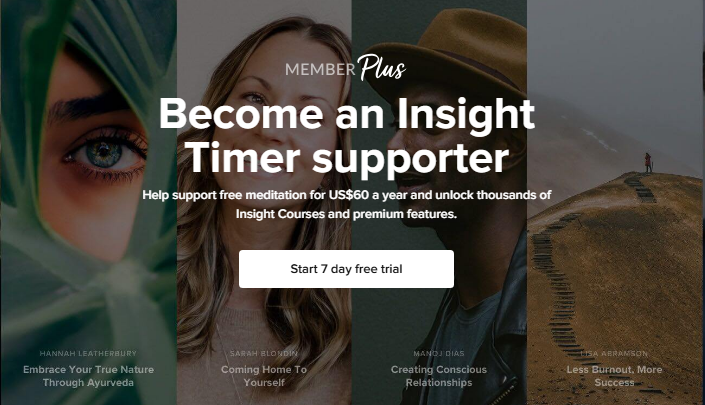
Source: Insight Timer
Choose Insight Timer if:
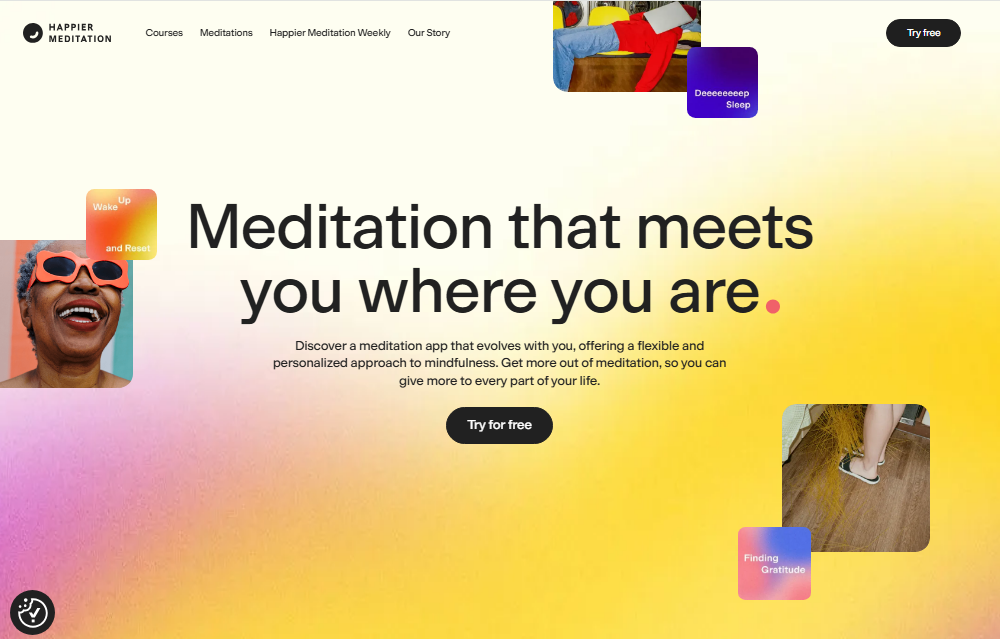
Happier Meditation is a mindfulness and meditation app founded in 2014 that calls itself “meditation for the rest of us”.
Co-founded by ABC News anchor Dan Harris (who experienced an on-air panic attack in 2004 while anchoring Good Morning America), the app was built on the premise that even self-proclaimed skeptics can benefit from meditation. In September 2024, the company rebranded from Ten Percent Happier to “Happier” following Harris’s departure.
Its key features include:
Happier stands out in several ways:
Educational Philosophy and Teaching Depth.
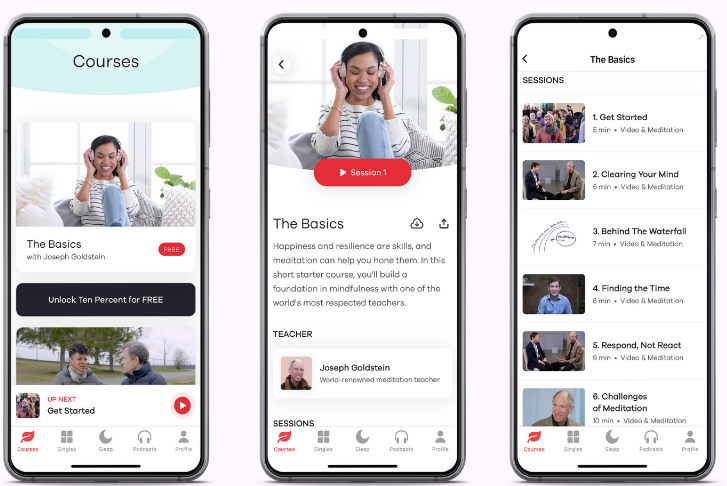
Happier’s central differentiator is its commitment to teaching the theory and science behind meditation. While Headspace excels at making meditation approachable, Happier provides 30+ courses with video lessons paired with meditations where users watch short ‘Learn’ videos explaining the reasoning and philosophy behind each technique.
This approach earned Happier 5 out of 5 stars for credibility and expertise in independent reviews. For analytical users who need to understand how something works before committing to it, this depth matters.
Source: Choosing Therapy
World-Class Meditation Teachers.
Happier features Joseph Goldstein, Sharon Salzberg, and Jeff Warren, household names in the meditation world. Joseph Goldstein co-founded the Insight Meditation Society and has taught meditation since 1974. Sharon Salzberg co-founded the same institution in 1975 and has authored bestselling books.
These aren’t just experienced teachers; they trained many of the meditation teachers working today. While Headspace prominently features Andy Puddicombe, the depth of Happier’s roster (particularly for users seeking recognized masters) is distinct.
The “No BS” Approach for Skeptics.
Happier’s most distinctive advantage is its explicit appeal to people who think meditation is “hokey” or “a bit of crock”. Dan Harris’s journey from skeptic to practitioner creates a relatable narrative. Research shows that professionals and lawyers particularly appreciate Happier because it discusses professional life in depth. The platform offers fully secular meditations, a good option for those who have avoided meditation due to religious associations.
We also evaluated Calm and Insight Timer for this archetype. Calm leans more toward relaxation and sleep. Insight Timer has thousands of teachers, but its user-generated model means variable content quality and less structured learning. Happier offers the strongest combination of skeptic-friendly positioning, credentials, and systematic educational content.
Choose Happier if:
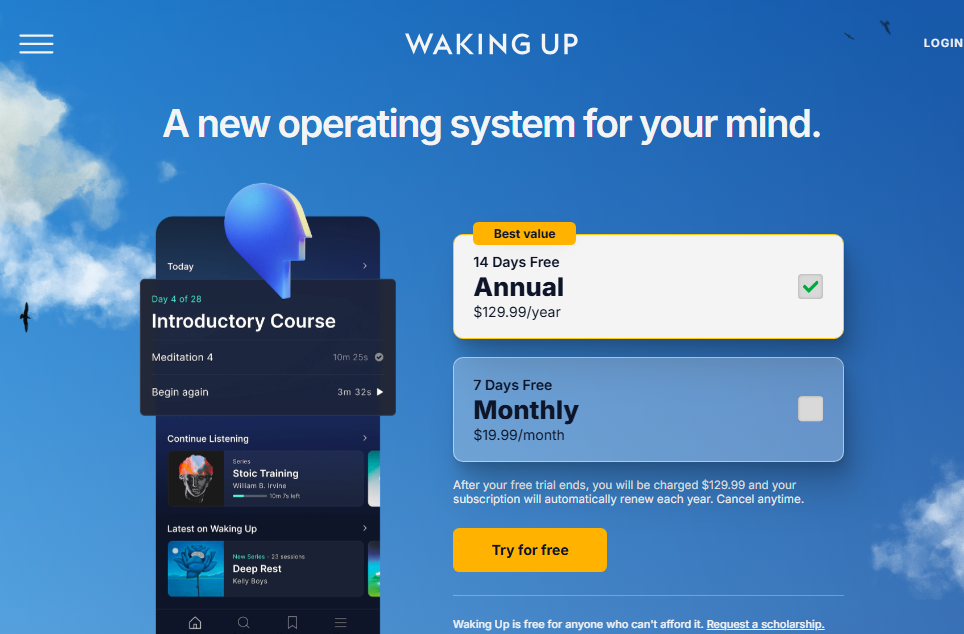
Waking Up is a meditation and mindfulness app created by neuroscientist and author Sam Harris. It bills itself as “A new operating system for your mind” and offers “real mindfulness, without any New Age fluff”. Harris practiced meditation for over 30 years and studied with Tibetan, Indian, Burmese, and Western teachers, bringing a combination of scientific rigor and contemplative depth.
Its key features include:
Waking Up stands out in several ways:
Theory-First Methodology That Teaches the “Why.”
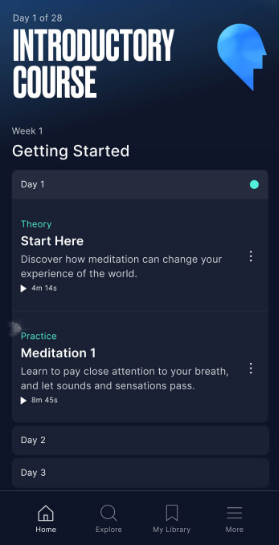
Waking Up helps users “understand the theory of mindfulness, with the best of ancient wisdom pressure-tested by modern science”. The platform “teaches you how to meditate AND why”, with a Theory & Lessons library covering Stoicism, effective altruism, sleep, psychedelics research, and more, plus the collected talks of Alan Watts. Each meditation comes with a complementary lesson, pairing practice with understanding.
Advanced Non-Dual Awareness Practices.
While Headspace teaches mindfulness focused on stress reduction, Waking Up offers instruction in nondual awareness practices from Dzogchen, Zen, and Advaita Vedanta. These traditions teach practitioners to “look for the observer” and discover experiences where “the feeling of separation between subject and object temporarily collapses”. For users who have practiced with Headspace and feel they’ve hit a plateau, Waking Up opens an entirely new dimension.
Neuroscience Credibility and Secular Spirituality.
Sam Harris holds a Ph.D. in cognitive neuroscience from UCLA where he researched the neural basis of belief using functional magnetic resonance imaging. Users praise the “secular approach with no woo whatsoever” and the platform’s commitment to being free from religious dogma while still drawing on ancient wisdom traditions. His credentials as the author of five New York Times bestsellers and host of the Webby Award-winning Making Sense Podcast reinforce this credibility.
Source: Waking Up
We also evaluated Insight Timer and Plum Village. Insight Timer offers a large free library from thousands of teachers, and Plum Village provides authentic Thich Nhat Hanh-inspired teachings. Waking Up offers the most complete integration of contemplative practices with philosophical inquiry.
Source: Waking Up
Choose Waking Up if:
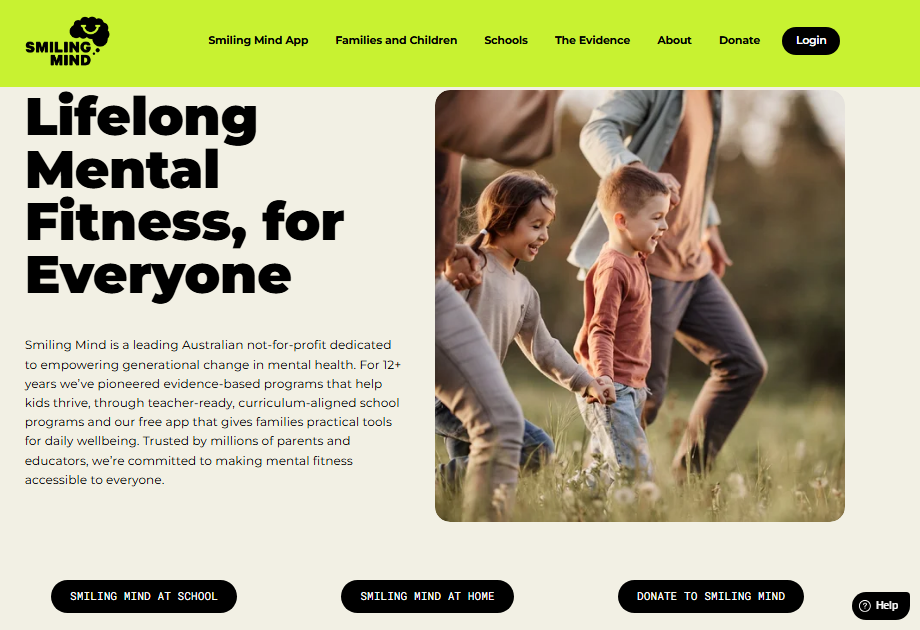
Smiling Mind is a 100% not-for-profit Australian mental health organization that provides a completely free mindfulness and meditation app with no paywalls, no ads, and no upsells. Founded in 2012, the platform has reached 9.8 million app downloads globally and supported 14.7 million children and young people worldwide.
Its key features include:
Smiling Mind stands out in several areas:
Completely Free Forever vs. Subscription-Based Access.
Smiling Mind is 100% free with no premium tier, providing unrestricted access to its entire library of over 700 sessions and 90+ collections. For families, this is significant: Smiling Mind serves an entire household at zero cost, while Headspace requires $12.99 per month or $69.99 annually per individual.
The nonprofit’s 12-year history since 2012 and philanthropic partnerships (including the DECJUBA Foundation’s $3.6 million over three years) show this free model is sustainable.
Family and Youth Programming.
Smiling Mind provides 16 child-focused collections with over 190 sessions for ages 5-12, with content starting as young as age three. A Deakin University study involving 12 schools, 104 teachers, and 1,853 students found improvements in sleep, wellbeing, emotional management, concentration, and school behavior, with students experiencing higher emotional distress showing the biggest improvements. Headspace offers some family content, but its age-specific programming is narrower than what Smiling Mind provides.
Structured Mental Fitness Skill-Building.
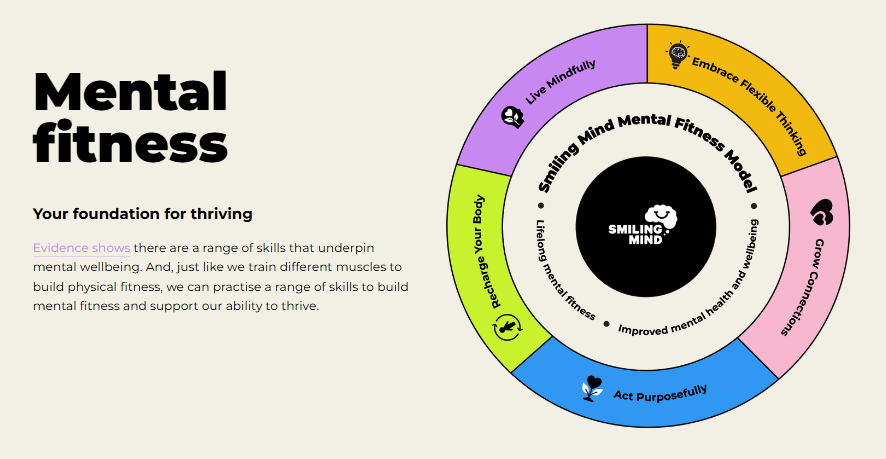
Smiling Mind’s Mental Fitness Model organizes content around five core skillsets, so users know which capacities they’re developing in each session. This gives families a shared language for children, parents, and educators and lets them discuss mental fitness using consistent terms. Headspace offers themed courses but doesn’t provide the same explicit framework connecting sessions to broader skill development.
Source: Smiling Mind
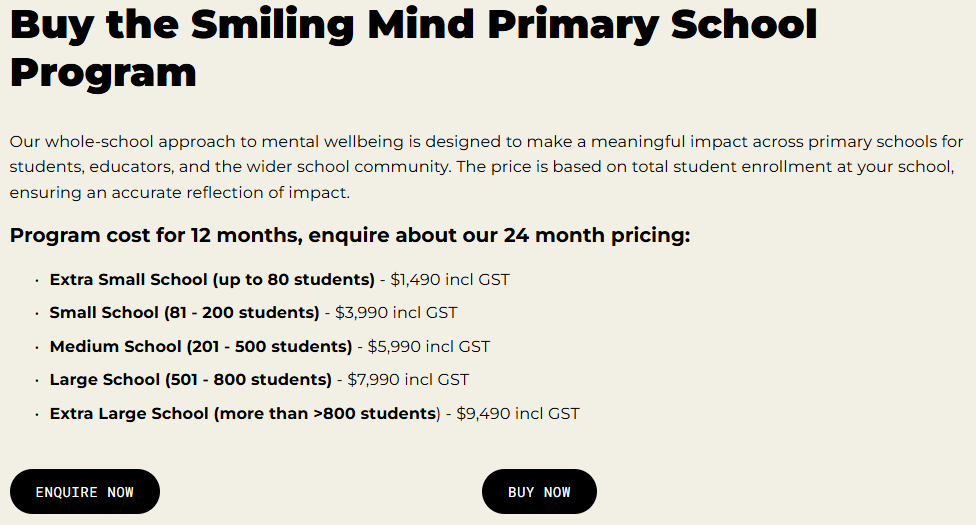
We also evaluated Medito and Liberate Meditation. Medito is free and open-source but has a smaller library and less family programming. Liberate offers valuable content for the BIPOC community but with a narrower focus. Smiling Mind's 700+ sessions, 16 child collections, 12-year track record, and research-validated impact in nearly 1,800 schools make it the strongest choice for families.
Source: Smiling Mind
Choose Smiling Mind if:
Balance is a personalized meditation app developed by The Mind Company (formerly Elevate Labs) that earned Google Play’s Best App of 2021 and holds a 4.9-star rating on the Apple App Store from 119,000 reviews. Unlike meditation apps with static content libraries, Balance assembles custom meditations from an audio library with thousands of files based on each user’s daily answers about their experience, goals, and obstacles.
Its key features include:
Balance stands out through a different approach:
Adaptive AI Personalization.
Headspace uses pre-recorded sessions that stay the same regardless of the user’s progress. Balance works as the first personalized meditation app, assembling meditations from dozens of clips woven together for each user’s current state.
An experienced user with a focus goal might get a session that skips introductory explanations, while a beginner working on stress reduction gets more foundational instruction. The app adapts continuously based on daily check-ins and post-session feedback, so content evolves with the user.
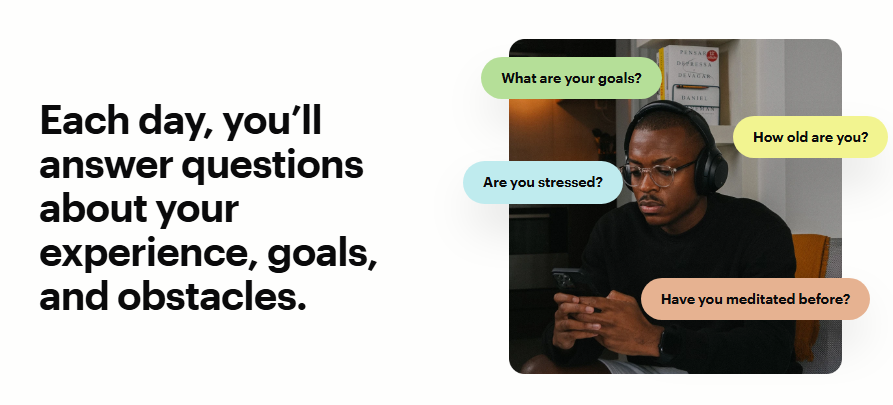
Source: Balance
Progressive Learning Paths with Mid-Plan Adjustments.
Balance’s 10-day Plans include assessment points that evaluate which skills the user has mastered and adjust remaining sessions accordingly. Headspace’s courses follow a fixed sequence every user experiences identically. If a user returns after a week-long gap, Balance checks current knowledge and provides refreshers on forgotten techniques; Headspace simply continues where it left off.
Extended Free Trial for Habit Formation.
Balance’s one-year free trial gives users twelve months to build a consistent practice before paying. Headspace offers 7 days for monthly or 14 days for annual subscriptions. Since building a meditation habit often takes months, Balance removes financial pressure during the entire formation period.
Multisensory Experience Through Haptic Technology.
Balance’s Immersive Meditations blend vibrations, sound effects, and coach guidance using haptic technology, letting users physically feel the meditation through device vibrations. The interactive Wind Down Single uses bilateral stimulation and controlled breathing with synchronized haptic feedback, which research suggests helps deactivate the amygdala, shifting the body from fight-or-flight to relaxation.
We also evaluated Insight Timer and Calm. Insight Timer excels at offering the largest free library with diverse teachers, and Calm is known for its Sleep Stories. Balance offers the strongest AI-powered personalization for users who need a meditation app that adapts to their progress rather than requiring them to search through thousands of options.
Choose Balance if:
Every app on this list is a self-guided wellness tool, and they’re genuinely helpful for building mindfulness habits, improving sleep, and managing everyday stress. But if you’ve been searching for Calm alternatives because you’re working through anxiety, depression, trauma, or other persistent mental health challenges, it’s worth asking whether self-guided meditation alone is giving you what you need.
That’s where professional therapy comes in, and CarePaths is where to look for accredited providers who use measurement-based care to track real outcomes.
CarePaths is a platform built for behavioral health professionals (licensed therapists, psychologists, and psychiatrists) that enables them to deliver measurement-based care (MBC).
Developed in collaboration with Dr. Bruce Wampold, one of the most cited psychotherapy researchers in the world, MBC involves regularly assessing patient outcomes using validated tools and using that data to inform clinical decisions. Research consistently shows that MBC improves therapy outcomes because it catches stalled progress early and prompts course corrections.
A 10-minute Daily Calm session can complement therapy well, but clinical anxiety, depression, PTSD, and trauma often require a licensed clinician who can diagnose conditions, develop a treatment plan, and adjust that plan based on measured progress over weeks and months. When your therapist uses a CarePaths-powered practice, they’re not guessing whether treatment is working. They have data.
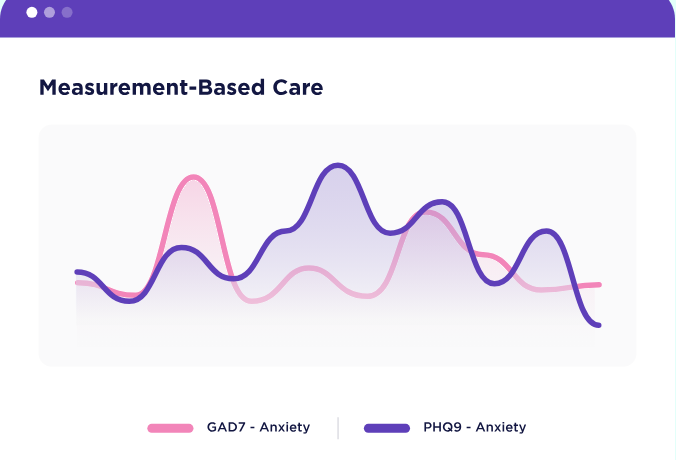
Source: CarePaths
The professionals accessible through CarePaths are licensed therapists, clinical psychologists, and board-certified psychiatrists who use approaches like Cognitive Behavioral Therapy (CBT), Dialectical Behavior Therapy (DBT), and EMDR, modalities clinically validated for specific conditions.
Through the CarePaths Connect patient portal, patients can schedule appointments, complete clinical assessments between sessions, participate in telehealth video sessions, and communicate securely with their provider, all through a HIPAA-compliant platform.
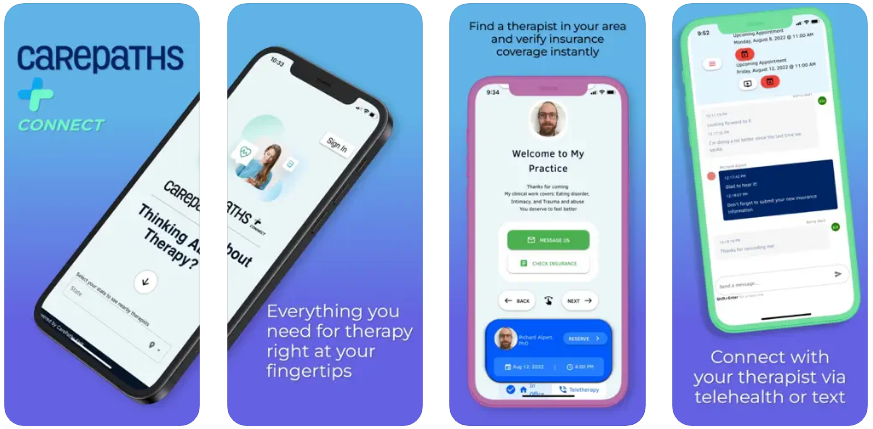
Source: Apple Store
CarePaths was founded in 2000 by Dr. Geoff Gray and Dr. Maureen Hart, both clinical psychologists who understood the daily challenges of running a behavioral health practice. This clinical foundation means CarePaths isn’t a tech company that entered healthcare. It’s a healthcare platform built by people who deliver care.
CarePaths offers a free Measurement-Based Care plan for providers serving up to 30 clients, making it accessible for practices of all sizes. For patients, the cost of therapy depends on their provider’s rates and insurance coverage. Many therapists who use CarePaths accept insurance, and the platform’s billing tools help practices process claims efficiently.
By Bruce Wampold PhD
Complete Practice Management System
Getting Started?
Consider looking into CarePaths-powered providers if:
Headspace remains an excellent introduction to mindfulness, offering a structured, beginner-friendly experience backed by science and delivered by a former Buddhist monk. But as your practice deepens or your needs sharpen, these alternatives each offer something Headspace doesn’t:
You don’t have to choose one platform. Many people combine a meditation app for daily practice with professional therapy for clinical needs, using each tool for its strength. The most important step is finding the right fit for where you are now.
If you're a mental health professional looking to offer data-driven therapy, or if you're ready to move from self-guided meditation to professional treatment, explore CarePaths and see how measurement-based care can make therapy more effective and transparent.