If you’ve been comparing Headspace’s monthly and annual subscription options, trying to decide whether $12.99/month or $69.99/year makes more sense for your mental wellness goals, you’ve probably noticed that the pricing is straightforward but the bigger question is harder: is a meditation app enough for what you actually need?
Headspace has become one of the most recognized names in digital mental health, offering guided meditations, sleep content, focus music, and mindfulness exercises to millions of users worldwide. The app delivers genuine value for everyday stress management and building a consistent meditation habit. Its pricing is simple: two main individual subscription plans that unlock the same full library of content, plus discounts for students and a family plan.
I’ve spent time analyzing Headspace’s pricing and what you actually get for your money. I believe it’s the ideal choice if:
However, Headspace’s standard subscription may not be sufficient if:
In this case, you should consider a fundamentally different approach: professional therapy supported by CarePaths. CarePaths is a behavioral health platform built for licensed therapists and psychiatrists, with a focus on Measurement-Based Care (MBC) that tracks patient outcomes to ensure treatment is actually working. If your mental health needs go beyond what a meditation app’s standard subscription can offer, CarePaths connects you with licensed providers who use clinical tools to monitor and improve your progress.
Because of that, I’ve included a detailed look at CarePaths’ pricing for professional therapy in this review, as an important option for anyone whose mental health needs extend beyond self-guided wellness.
Table of Contents:
| Headspace | CarePaths (for Therapists & Patients) | |
|---|---|---|
| Free Option | 7-day free trial (monthly), 14-day free trial (annual), no permanent free plan (limited free content available) | Free MBC tools for up to 30 clients, 30-day free EHR trial, no credit card required |
| Entry Level | Monthly: $12.99/month, full library access, cancel anytime | Getting Started: $10/month per clinician, up to 15 sessions/month, core EHR features |
| Standard | Annual: $69.99/year ($5.83/month), same full library access, 14-day free trial | EHR + MBC: $49/month per clinician, includes telehealth, billing, AI notes |
| Premium | Student Plan: 85% discount, Family Plan available | Psychiatry EHR: $98/month, e-prescribing included, PDMP integration |
| Best For | Individuals wanting self-guided meditation, sleep content, and mindfulness exercises for everyday wellness | Licensed therapists and psychiatrists delivering professional, measurement-based mental health treatment |
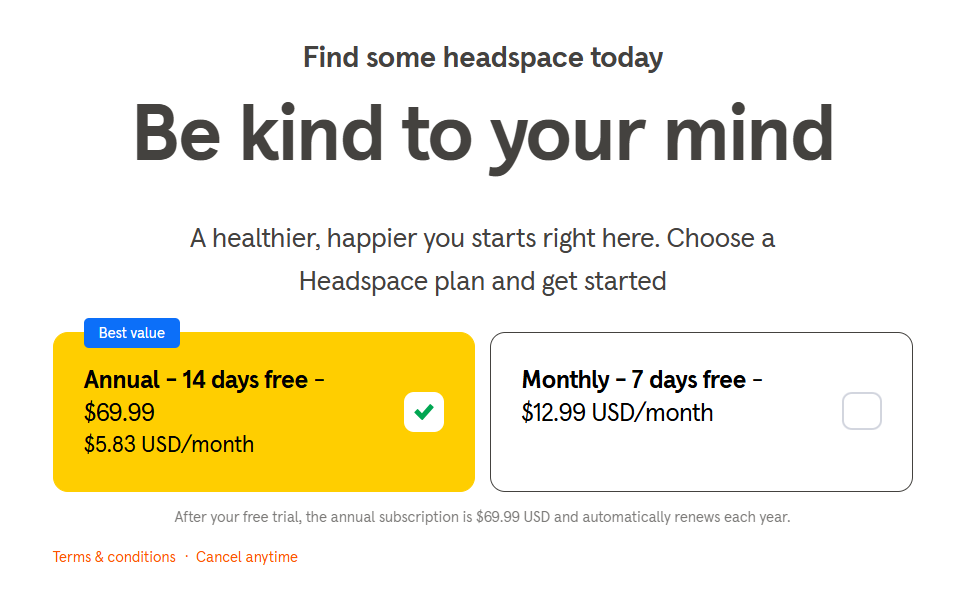
Headspace uses a simple subscription model with two main plans for individual users. Both plans unlock the exact same content library; the only difference is the billing cycle and free trial length. The platform also offers discounted plans for students and families. Let’s look at what each option includes and what it costs.
Source: Headspace
| Feature | Details |
|---|---|
| Price | $12.99/month |
| Free Trial | 7 days |
| Content Access | Full library |
| Billing | Monthly, cancel anytime |
| Offline Downloads | Available for most content |
The monthly plan gives you full access to Headspace’s entire library, including guided meditations, daily meditation sessions, sleepcasts, sleep sounds, focus music, movement exercises, and the Wake Up feature with daily stories. The 7-day free trial lets you test the content before committing. This plan works for users who want flexibility without an annual commitment. Note that while most sessions can be downloaded for offline use, some content like Sleepcasts and The Wake Up cannot be downloaded.
| Monthly Subscription | |
|---|---|
| Pros | Cons |
| ✅ Full access to all content categories | ❌ More than double the annual plan's monthly cost |
| ✅ Cancel anytime with no penalty | ❌ Shorter 7-day free trial |
| ✅ No long-term commitment required | ❌ No professional mental health support included in the standard subscription |
| ✅ Offline downloads for most content | ❌ Same features as the cheaper annual plan |
The Bottom Line 👉 The monthly plan suits users who want to try Headspace without a year-long commitment, but if you plan to stick with it, the annual plan saves you over 55%.
| Feature | Details |
|---|---|
| Price | $69.99/year ($5.83/month) |
| Free Trial | 14 days |
| Content Access | Full library |
| Billing | Annually |
| Savings | 55% vs monthly |
The annual plan is Headspace’s best value option, cutting the effective monthly cost from $12.99 to $5.83. You get the exact same content library as the monthly plan: Meditate, Sleep, Move, Focus, and Wake Up. The 14-day free trial gives you more time to explore before being charged.
| Annual Subscription | |
|---|---|
| Pros | Cons |
| ✅ 55% cheaper than paying monthly | ❌ Requires upfront $69.99 payment |
| ✅ 14-day free trial for thorough testing | ❌ Locked in for a full year |
| ✅ Identical content to the monthly plan | ❌ Auto-renews after the trial |
| ✅ Works out to less than $6/month | ❌ No refund for unused months |
The Bottom Line 👉 The annual plan is the clear choice for committed users at $5.83/month, but the upfront cost means you should use the 14-day trial to make sure Headspace fits your routine.
| Feature | Details |
|---|---|
| Price | 85% off standard pricing |
| Eligibility | Post-secondary/university students |
| Verification | Verified through SheerID (student ID, transcript, or enrollment letter accepted) |
| Content Access | Full library |
Headspace offers post-secondary and university students an 85% discount on its subscription, bringing the annual price down to $9.99/year. This requires verification through SheerID, a student-status validation service that accepts various forms of documentation including class schedules, transcripts, enrollment letters, or student ID. The plan includes the same full content library as the standard subscriptions.
| Student Plan | |
|---|---|
| Pros | Cons |
| ✅ 85% savings is substantial | ❌ Requires student verification |
| ✅ Full feature access | ❌ Only available to post-secondary students |
| ✅ Accessible price point for students | ❌ Transitions to a 40% off alumni rate for one year after graduation, then reverts to full price |
The Bottom Line 👉 The student plan makes Headspace extremely affordable for eligible students, and the alumni discount provides a one-year transition period before full pricing kicks in.
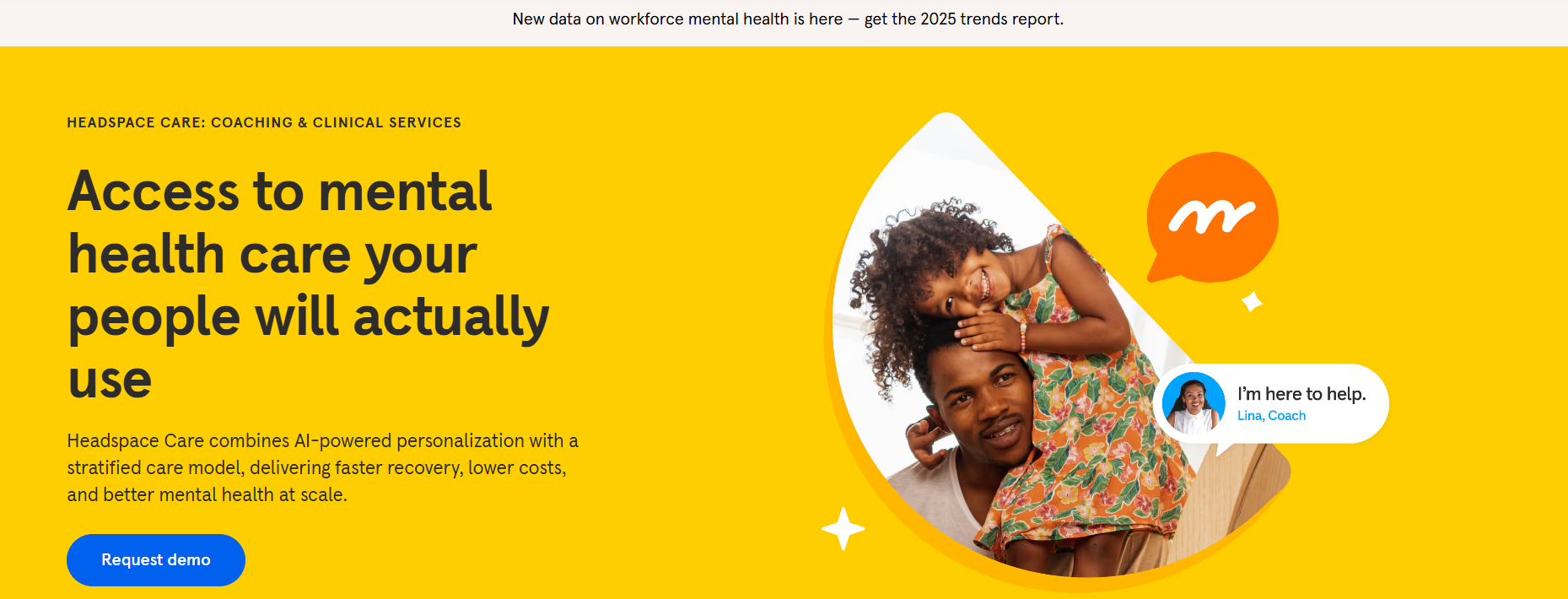
Beyond the standard subscription, Headspace promotes mental health coaching as a separate service. The main pricing page mentions the option to connect with an expert coach, though specific pricing details for coaching are not listed alongside the subscription plans.
Headspace Care, the platform’s clinical part, offers coaching, therapy, and psychiatry services primarily through employer partnerships. Employees at participating companies may access these services at reduced cost or free, depending on their benefits plan. This is a separate product from the standard Headspace subscription.
Source: Headspace
Headspace does an excellent job making meditation and mindfulness accessible. Its content library is well-produced, the app is easy to use, and the pricing is affordable. However, for users whose mental health needs go beyond daily wellness habits, the standard meditation subscription has real limitations:
No Professional Clinical Treatment in the Standard Subscription
Limited Clinical Outcome Measurement
No Personalized Treatment Plans
Limited Scope for Serious Mental Health Needs
For users who realize they need structured, professional mental health treatment, the question shifts from “which meditation app?” to “how do I find a therapist who actually tracks whether treatment is working?”
CarePaths takes a different approach to mental health by providing the infrastructure for professional, clinical treatment delivered by licensed therapists and psychiatrists.
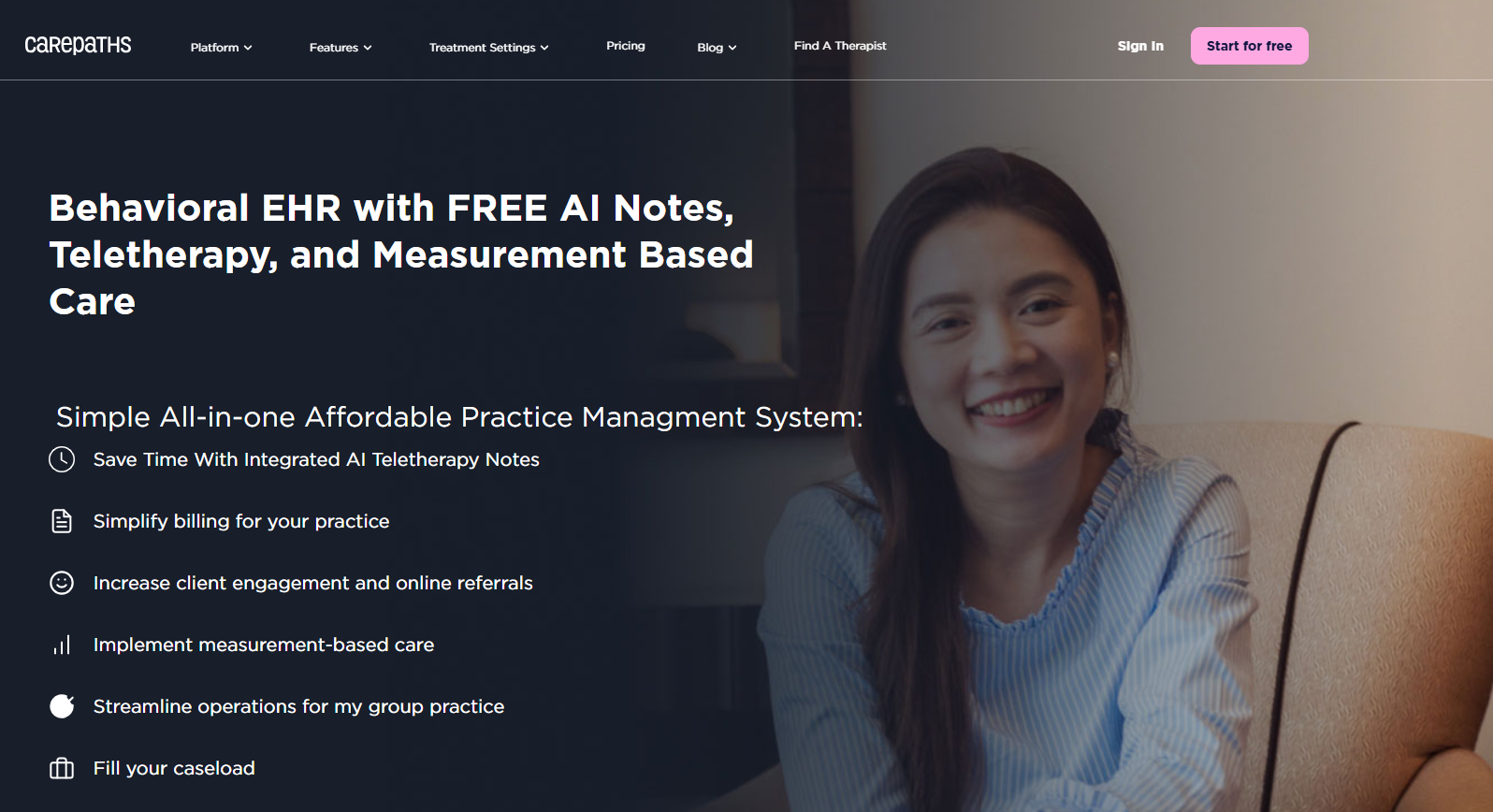
While Headspace’s standard subscription offers self-guided wellness content, CarePaths addresses a different need entirely: connecting patients with licensed behavioral health professionals who use Measurement-Based Care (MBC) to track treatment outcomes and adjust care plans based on real clinical data.
Source: CarePaths
Founded in 2000 by clinical psychologists Dr. Geoff Gray and Dr. Maureen Hart, CarePaths is an ONC-certified, HIPAA-compliant Electronic Health Record (EHR) and practice management platform. The platform’s MBC tools, developed with Dr. Bruce Wampold, automate the collection of patient-reported outcomes using over 40 customizable assessments, so therapists can see whether treatment is actually working, not just whether a patient showed up.
For individuals exploring options for their mental health, CarePaths provides a path to professional therapy where progress is measured, treatment plans are personalized, and care is delivered by licensed clinicians. The platform also includes a patient portal and mobile app (CarePaths Connect) for scheduling, secure messaging, telehealth sessions, and completing assessments between sessions.
| Feature | Details |
|---|---|
| Price | Free (up to 30 clients per clinician) |
| Unlimited Option | $9/clinician/month |
| Assessments | 40+ customizable instruments |
| Outcome Tracking | Automated patient-reported outcomes |
| Referral Tool | Digital-Front-Door for online referrals |
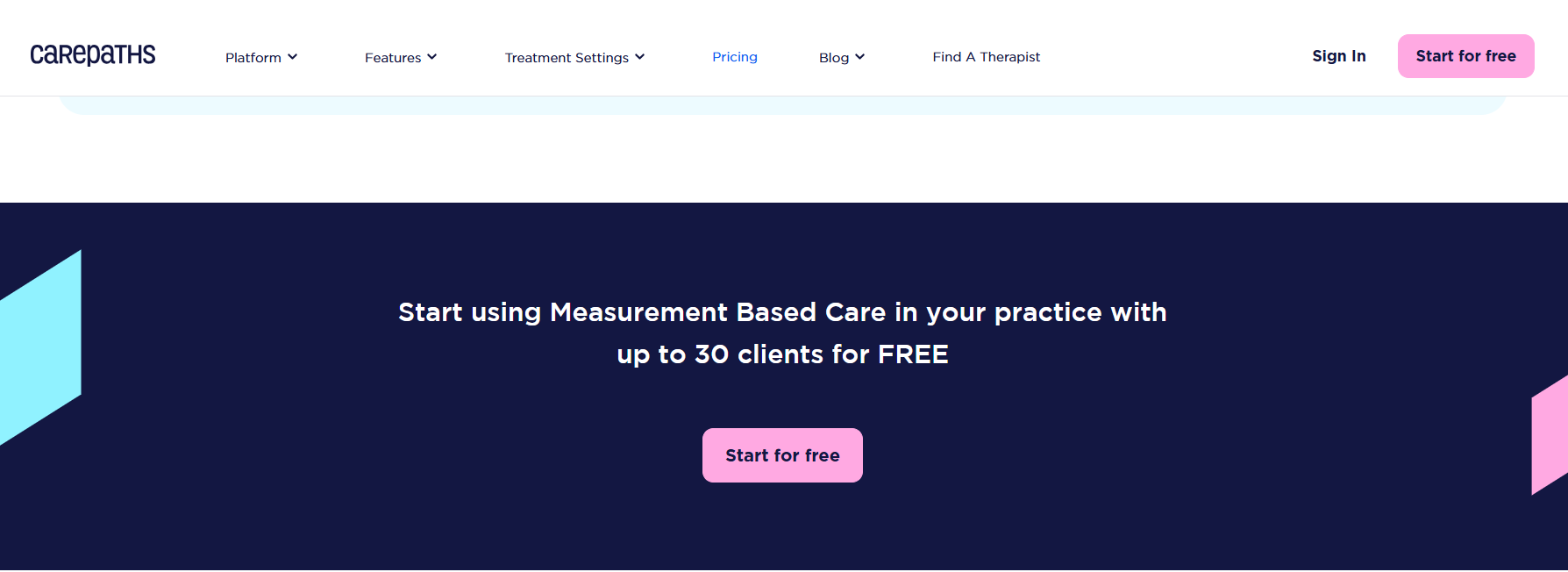
CarePaths offers its Measurement-Based Care tools free for clinicians with up to 30 clients. This includes automated outcome tracking, medication adherence monitoring, and access to over 40 clinical assessments. For patients, this means your therapist can use validated instruments to measure your progress session over session, providing a level of clinician-directed outcome tracking that goes well beyond what a self-guided wellness app offers.
Source: CarePaths
| MBC Free Plan | |
|---|---|
| Pros | Cons |
| ✅ Completely free for smaller caseloads | ❌ Limited to 30 clients per clinician |
| ✅ 40+ clinical assessments available | ❌ Doesn't include full EHR features |
| ✅ Evidence-based outcome tracking | ❌ No practice management tools |
| ✅ Designed to minimize administrative burden on therapists | ❌ No billing or scheduling included |
The Bottom Line 👉 The free MBC plan gives clinicians access to outcome tracking that proves whether therapy is working, at no cost for practices with 30 or fewer clients.
| Feature | Details |
|---|---|
| Price | $49/month per licensed therapist |
| Telehealth | Included (individual and group) |
| Billing | Electronic billing with free claims |
| Patient Portal | Included with mobile app |
| AI Notes | AI-generated clinical notes included |
| Free Trial | 30 days, no credit card required |
The full EHR plan gives therapists everything they need to run a practice: clinical documentation, treatment plans, scheduling, billing with free claims processing, free SMS appointment reminders, telehealth, a patient portal, AI-generated clinical notes, and automated MBC. At $49/month, CarePaths includes features that competitors like SimplePractice ($99+/month) charge significantly more for. For comparison, TherapyNotes starts at $69/month for solo practices, with popular add-ons like premium telehealth and AI tools pushing the total higher.
| EHR + MBC Plan | |
|---|---|
| Pros | Cons |
| ✅ All-in-one: EHR, billing, telehealth, MBC | ❌ Built for clinicians, not consumers directly |
| ✅ Free claims, reminders, and eligibility checks | ❌ Learning curve for new EHR users |
| ✅ AI-generated session notes save time | ❌ Interface may feel less polished than competitors |
| ✅ 30-day trial with no credit card required | ❌ Storage fees apply above 5GB |
The Bottom Line 👉 At $49/month, CarePaths gives therapists a complete practice management system with outcome tracking included, making professional therapy more accessible and accountable for patients.
| Feature | Details |
|---|---|
| Price | $10/month |
| Session Limit | 15 sessions/month |
| Features | Core EHR features |
| Best For | New or part-time practitioners |
For therapists just starting their practice or working part-time, CarePaths offers its Getting Started plan at $10/month with a cap of 15 sessions per month. This low entry point makes professional therapy infrastructure available even to clinicians building their caseload.
| Feature | Details |
|---|---|
| Price | $98/month |
| E-Prescribing | Controlled and legend drugs |
| PDMP | Integrated monitoring |
| Additional Setup | $80 enrollment per prescriber + $599 PDMP enrollment per practice |
| All EHR Features | Included |
The Psychiatry EHR adds e-prescribing for both controlled substances and legend drugs, along with PDMP integration, decision support, and medication history tracking. This plan is relevant for patients who need medication management alongside therapy, a level of clinical care that goes beyond what a standard wellness subscription provides.
| Role | Monthly Cost |
|---|---|
| Licensed Therapist | $49/month |
| Part-Time Therapist | $34/month |
| Student Clinician | $5.75/month |
| Administrative Staff | Unlimited, free |
Group practices benefit from planned pricing that scales with team composition, plus a 30-day free trial and unlimited administrative staff accounts at no extra cost.
Headspace’s Approach: Headspace provides a library of pre-recorded guided meditations, sleep content, movement exercises, and focus music. Users choose what to listen to based on their mood or goals. The content is well-produced and backed by clinical research on mindfulness benefits, though the standard subscription experience is primarily self-directed: the app delivers content, and the user decides how to engage with it.
CarePaths’ Approach: CarePaths enables licensed clinicians to deliver personalized therapy with treatment plans tailored to each patient’s specific diagnosis and needs. Progress is tracked through validated clinical assessments, and treatment can be adjusted based on real outcome data. This is clinician-directed care integrated into a professional treatment workflow.
These aren't competing approaches; they serve different needs. Headspace is designed for daily wellness maintenance. CarePaths supports professional treatment for clinical mental health conditions. For many people, the best approach is both: a meditation practice for daily maintenance and professional therapy for clinical needs.
Headspace’s Approach: Headspace tracks meditation streaks, total minutes meditated, and sessions completed. These are engagement metrics that show consistency. Headspace also offers a “My Progress” feature that includes some validated scales like the Perceived Stress Scale and GAD-7, but these are self-administered without integration into a clinician-directed treatment plan.
CarePaths’ Approach: CarePaths automates Measurement-Based Care using over 40 validated clinical assessments (such as the PHQ-9 for depression or GAD-7 for anxiety). Patients complete these instruments between sessions, giving therapists objective data on whether treatment is producing results. When scores indicate a need for change, the therapist can adjust the approach based on that data.
While both platforms offer some form of outcome measurement, CarePaths provides a significantly deeper clinical workflow: 40+ assessments integrated into a therapist-managed treatment plan where a licensed professional reviews the data and adjusts care accordingly. For anyone dealing with a diagnosable mental health condition, this level of clinician-directed outcome tracking is a meaningful step beyond self-administered assessments.
Headspace’s Approach: At $5.83/month (annual) or $12.99/month, Headspace is accessible to most people with a smartphone. The low price point and self-service model mean you can start immediately with no appointments, no waiting lists, and no insurance paperwork.
CarePaths’ Approach: CarePaths’ pricing is per-clinician (starting at $10/month for the Getting Started plan), meaning the cost to patients depends on their therapist’s fees and insurance coverage. However, CarePaths helps keep therapy costs down by including free claims processing, eligibility verification, and telehealth, reducing overhead that practices might otherwise pass on to patients.
By Bruce Wampold PhD
Complete Practice Management System
Getting Started?
🪙 Value Verdict: Headspace wins on immediate, low-cost accessibility. But for users who need professional treatment, CarePaths helps make therapy more affordable and efficient by reducing the administrative costs that inflate therapy prices.
The choice between Headspace and CarePaths depends on what your mental health actually needs right now:
👍Headspace is a well-designed mindfulness and meditation app built for daily wellness habits. With pricing at $12.99/month or $69.99/year ($5.83/month), it provides a full library of guided meditations, sleep content, focus music, and movement exercises. This pricing works best for individuals building a mindfulness routine, people managing everyday stress, and anyone wanting an affordable, self-paced approach to mental wellness. The student plan's 85% discount makes it especially accessible for younger users.
Get started with Headspace here.
👉CarePaths is a behavioral health platform built on Measurement-Based Care, designed for licensed therapists and psychiatrists who deliver professional mental health treatment. With clinician pricing from free (MBC for up to 30 clients) to $49/month (full EHR) and $98/month (psychiatry with e-prescribing), it provides the clinical infrastructure for treatment that's tracked, measured, and adjusted based on real outcomes. This approach matters for anyone dealing with clinical mental health conditions, individuals who want a therapist who uses validated assessments to track progress, and patients who need more than self-guided content.
Get started with CarePaths here.
The fundamental difference is in what each platform asks. Headspace asks "How can we help you build a daily wellness habit?" CarePaths asks "How can we ensure that professional therapy is actually working?" For many people, the honest answer is that they benefit from both: a meditation practice for everyday maintenance and professional, measurement-based therapy for the clinical work that a wellness app's standard subscription was never designed to do.*
No, Headspace does not offer a permanent free plan, though a small amount of introductory content remains accessible without a subscription. It provides a 7-day free trial on the monthly plan ($12.99/month) and a 14-day free trial on the annual plan ($69.99/year). After the trial, the subscription auto-renews at the selected rate. There is a separate student plan with an 85% discount for verified post-secondary students.
The annual plan at $69.99/year ($5.83/month) saves over 55% compared to the monthly plan at $12.99/month. Both plans include full library access. The annual plan also includes a longer 14-day free trial versus the monthly plan’s 7-day trial. Unless you’re unsure about committing, the annual plan offers better value.
Both subscription tiers include full access to guided meditations, daily meditations, sleep content (sleepcasts, sleep sounds), focus music, movement exercises, and the Wake Up feature. Offline downloads are available on mobile for most content, though some items like Sleepcasts and The Wake Up cannot be downloaded. Mental health coaching and clinical services through Headspace Care are separate from the standard subscription.
Headspace is a wellness tool, not a replacement for professional therapy. Meditation and mindfulness can help with everyday stress, sleep, and focus, and they can complement clinical treatment. But for diagnosable mental health conditions like depression, anxiety disorders, PTSD, or conditions requiring medication, professional therapy with a licensed clinician is recommended. Platforms like CarePaths help therapists deliver and track professional treatment using validated clinical assessments.
CarePaths is a platform for therapists and psychiatrists, not a direct-to-consumer app. Its pricing (free MBC for up to 30 clients, $49/month for full EHR, $98/month for psychiatry) is charged to clinicians. For patients, the cost of therapy depends on the therapist’s rates and insurance coverage. CarePaths helps reduce overhead by including free claims processing, telehealth, and appointment reminders in its base price, which can help keep therapy costs manageable.
Yes, and many mental health professionals recommend exactly this. A daily meditation practice through Headspace can support the work you do in therapy sessions. CarePaths’ MBC tools let your therapist track whether professional treatment is producing measurable improvement, and a personal wellness practice can complement that clinical work. Research suggests the two approaches can address complementary aspects of mental health, though the best combination depends on individual needs.