Bruce Wampold, PhD · Chief Clinical Officer, CarePaths
“Linguistics offers a unique perspective on conversational dyads that can be invaluable to those of us trying to understand and improve psychotherapy.”
— Bruce Wampold, PhD, Chief Clinical Officer, CarePaths Inc.
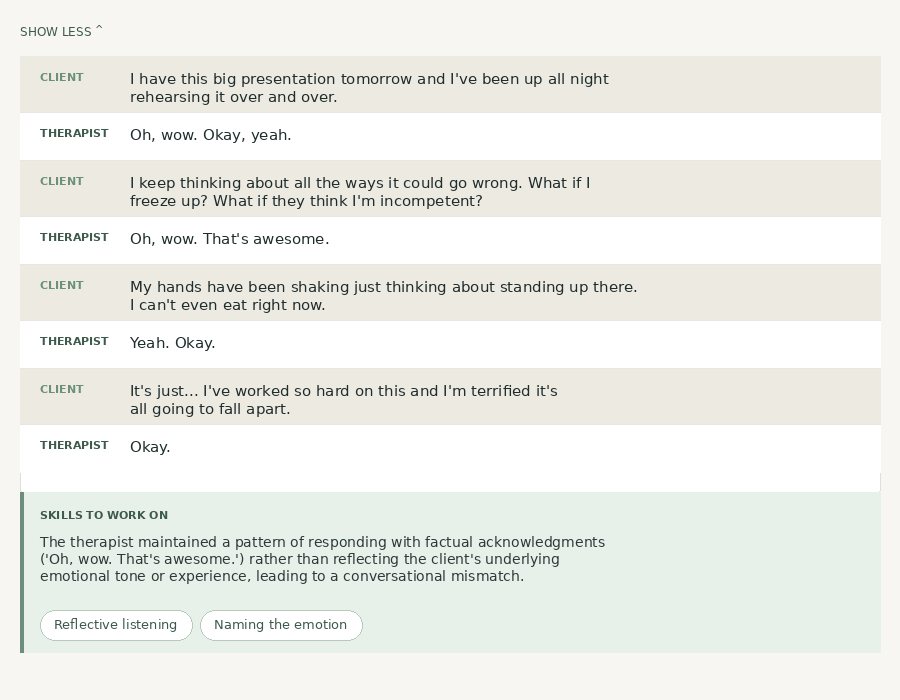
Linguistic studies of conversations have identified attunement as a strong indicator of the quality of exchanges in dyads and groups. Attunement looks at how similar conversational partners are in the use of certain types of words or parts of speech — without considering the actual content of their conversation.
Findings relevant to psychotherapy include:
We developed the Psychotherapy Attunement Scale (PAS) to measure therapist-patient attunement. We’re eager to find out if therapists can use this information to improve psychotherapy.
The PAS is automatically calculated from therapy session transcripts generated by our AI progress note feature or created from teletherapy transcripts. The results are included with the Measurement-Based Care (MBC) report. You’ll be able to see how attunement varies from session to session. Within each session, we’ll show you the parts of the session where attunement was low.
We think low attunement indicates problems in patient-therapist understanding. Pinpointing the moments of low attunement will help the therapist address these problems.
But these are just our hypotheses. A critical first step is to get feedback from practicing therapists, like you.
We are eager to hear about your experience with the PAS. Is the information useful? Does it help you spot or understand issues in the therapeutic alliance you might have otherwise missed? Does it help with supervision?
Please share your thoughts — we read every piece of feedback, and it shapes what we build next.
Here are a few research studies on the use of linguistic attunement:
Aafjes-van Doorn, K., & Müller-Frommeyer, L. (2020). Reciprocal language style matching in psychotherapy research. Counselling and Psychotherapy Research, 20(3), 449–455. https://doi.org/10.1002/capr.12298
Schaper, R., Nowotny, C., Michalek, S., Schmidt, U., & Brockmeyer, T. (2023). Language style matching and treatment outcome in anorexia nervosa. European Eating Disorders Review, 31(1), 110–120. https://doi.org/10.1002/erv.2943